
Literature高分文献爆款产品——ROS活性氧检测攻略大全
活性氧(Reactive oxygen species, ROS)是细胞代谢的正常产物——一种含氧的生物活性分子,包括过氧化物、超氧化物、羟基自由基、单线态氧和α-氧等,在细胞信号通路、转录等方面发挥重要的调控功能,如细胞凋亡、自噬、衰老、癌症等都与活性氧有关。
研究背景——什么是ROS?
活性氧(Reactive oxygen species, ROS)是细胞代谢的正常产物——一种含氧的生物活性分子,包括过氧化物、超氧化物、羟基自由基、单线态氧和α-氧等,在细胞信号通路、转录等方面发挥重要的调控功能,如细胞凋亡、自噬、衰老、癌症等都与活性氧有关。
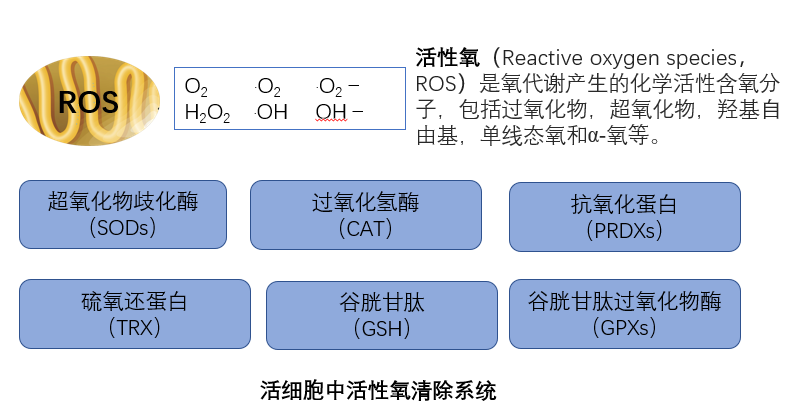
ROS浓度高低对细胞的影响
——为什么要测ROS?
在活性氧水平较低时,ROS作为“氧化还原信使”参与细胞内的信号传递和调节。然而,在环境压力下(例如电离辐射、热暴露、紫外线、缺氧等),ROS水平会急剧增加,可能引起DNA损伤,抑制基因表达,导致蛋白质错误折叠甚至影响蛋白质合成,对细胞结构造成严重损害,这被称为氧化应激。
ROS水平一旦超过内源性抗氧化防御的能力,氧化还原平衡被破坏,就会导致DNA、脂质、蛋白质的结构或构像改变,最终导致细胞死亡。
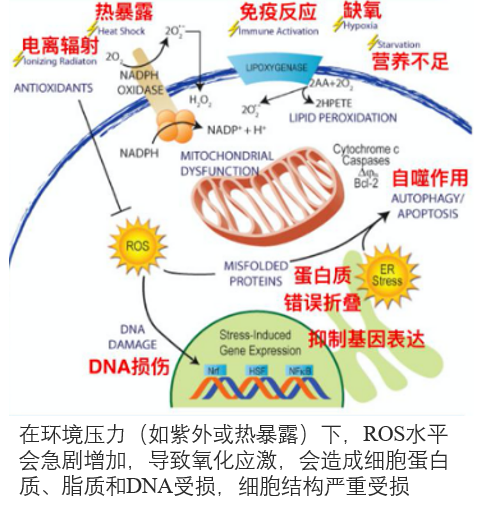
ROS水平是细胞正常生理功能和环境因素导致细胞损伤的重要信号,检测细胞内ROS水平对于理解一些药物作用的信号通路和潜在作用机制具有重要意义。因此选择合适的探针检测ROS对于疾病机理研究以及药物筛选具有重要的作用。
ROS检测的原理——
检测的机理是什么?
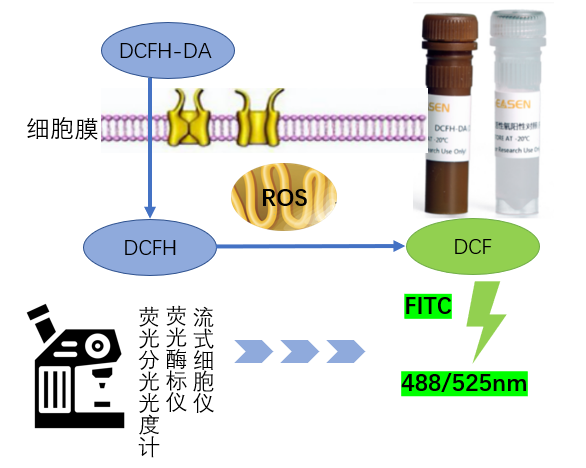
活性氧检测试剂盒(Reactive Oxygen Species Assay Kit)(CAT# 50101ES01)是一种基于荧光染料DCFH-DA (2,7-Dichlorodi -hydrofluorescein diacetate)的荧光强度变化,定量检测细胞内活性氧水平的最常用方法。
DCFH-DA本身没有荧光,可以自由穿过细胞膜,进入细胞内后,可以被细胞内的酯酶水解生成DCFH。而DCFH不能透过细胞膜,从而使探针很容易被标记聚集在细胞内。细胞内的活性氧能够氧化无荧光的DCFH生成有荧光的DCF。DCF绿色荧光强度与细胞内活性氧水平成正比,检测DCF的荧光就可以知道细胞内活性氧水平。
在激发波长488 nm,发射波长525 nm条件下,使用荧光显微镜、激光共聚焦显微镜、荧光分光光度计、荧光酶标仪、流式细胞仪等检测DCF荧光,从而测定细胞内活性氧水平。
客户使用本产品发表的文献(部分举例)
截止2022年9月,ROS活性氧检测试剂盒(50101ES01)已累计发表文献164篇,总影响因子913.72。
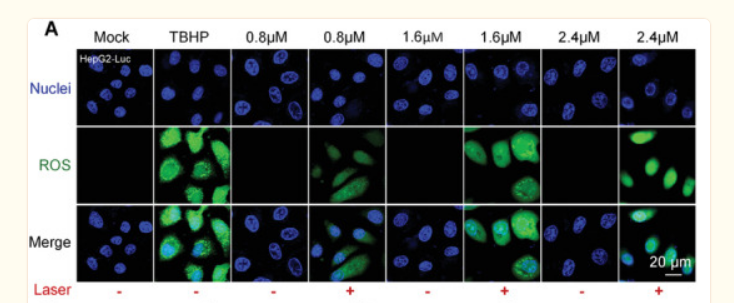
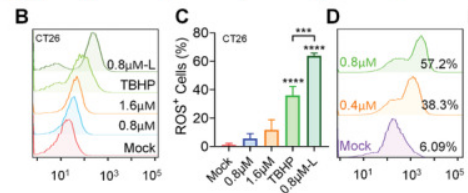
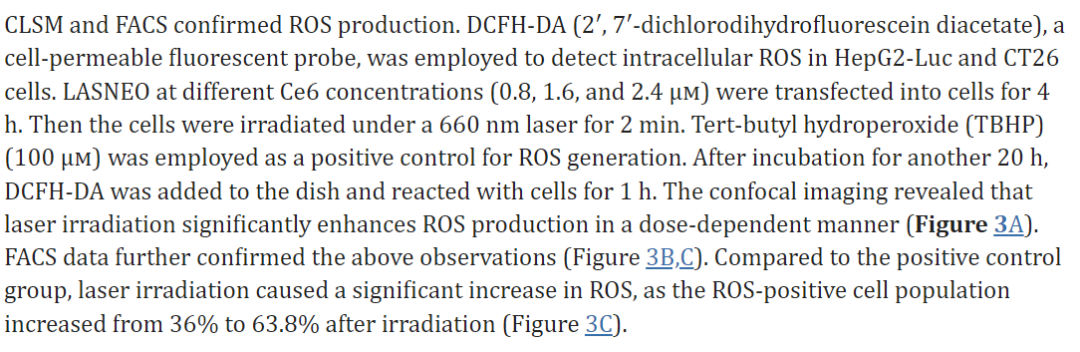
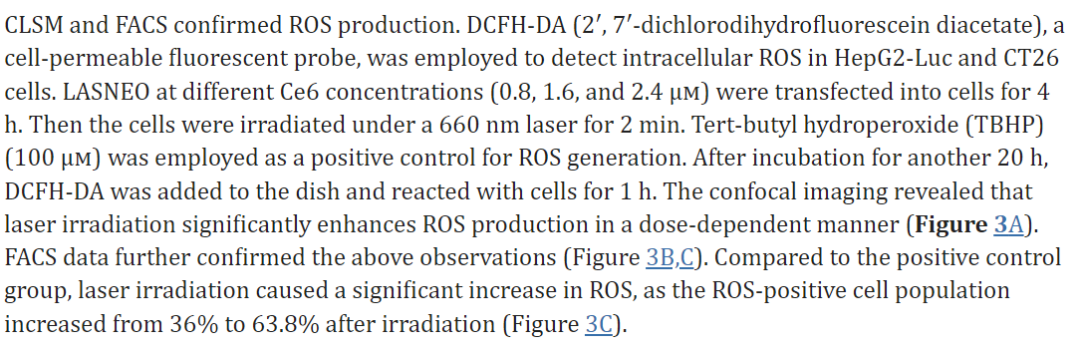

ROS产生对巨噬细胞极化及肿瘤细胞杀伤的影响图片来源于文章PMID: 35665496; PMCID: PMC9353410.

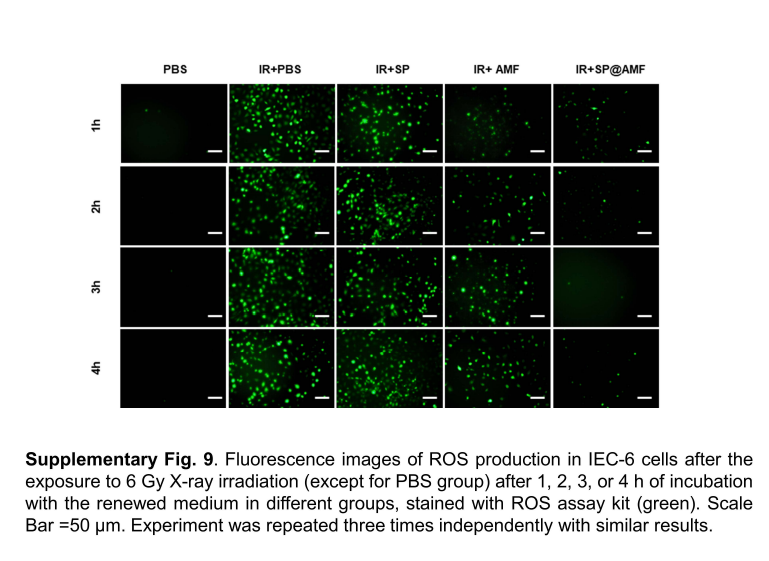
图片来源于文章PMID: 35301299; PMCID: PMC8931093
常见FAQ
A1:一般用于哺乳动物细胞的检测,只适合活细胞或活体的活性氧检测。
A2:不适合用于血清或组织匀浆液ROS的检测。新鲜组织制备的单细胞悬液可以尝试。
A3:只适合活细胞或活体的活性氧检测,因为氧的羟基自由基和超氧自由基的半衰期极短,只适合活细胞的检测。植物或细菌,可以在制备原生质体后进行检测使用,该试剂盒不能检测体内的ROS。
A4:探针孵育后,一定要洗净残余的未进入细胞内的探针。
A5:正常细胞中活性氧含量很低,检测效果可能不会很好。
A6:可能是加入的探针浓度过大导致的,建议适当降低探针浓度:5-7.5 μM,同时降低孵育时间:15-20 min
A7:阳性对照Rosup通常浓度为100 μM,刺激后30 min-4 h可以观察到显著的活性氧水平升高。对于不同的细胞,活性氧阳性对照的效果可能有较大的差别。如果在刺激后30 min内观察不到ROS的升高,可延长诱导时间或适当提高Rosup的浓度。
A8:1.细胞状态不好,导致染色效率低;2.阳性药物诱导时间过短,一般37℃避光孵育30 min-4 h可显著看到活性氧水平提高;3.探针反复冻融4次以上,染色效率降低,荧光信号不稳定(时强时弱、易猝灭)。建议探针分装,避光保存在-20°C冰箱中,避免反复冻融。
A9:荧光显微镜、激光共聚焦显微镜、荧光分光光度计、荧光酶标仪、流式细胞仪等都可以检测荧光值。
客户使用本产品发表的科研文献(部分)
向下滑动查看
[1] Zhang M, et al. Conscription of Immune Cells by Light-Activatable Silencing NK-Derived Exosome (LASNEO) for Synergetic Tumor Eradication. Adv Sci (Weinh). 2022 Aug;9(22): e2201135. doi: 10.1002/advs.202201135. Epub 2022 Jun 4. IF: 16.806
[2] Zhang D, et al. Microalgae-based oral microcarriers for gut microbiota homeostasis and intestinal protection in cancer radiotherapy. Nat Commun. 2022 Mar 17;13(1):1413. doi: 10.1038/s41467-022-28744-4. PMID: 35301299. IF: 14.919
[3] Jiao D, et al. Biocompatible reduced graphene oxide stimulated BMSCs induce acceleration of bone remodeling and orthodontic tooth movement through promotion on osteoclastogenesis and angiogenesis. Bioact Mater. 2022 Feb 6; 15:409-425. doi: 10.1016/j.bioactmat.2022.01.021. PMID: 35386350; PMCID: PMC8958387. IF: 14.593
[4] Guo G, et al. Space-Selective Chemodynamic Therapy of CuFe5O8 Nanocubes for Implant-Related Infections. ACS Nano. 2020 Oct 27;14(10):13391-13405. doi: 10.1021/acsnano.0c05255. Epub 2020 Sep 22. PMID: 32931252. IF: 14.588
[5] Yang C, et al. Red Phosphorus Decorated TiO2 Nanorod Mediated Photodynamic and Photothermal Therapy for Renal Cell Carcinoma. Small. 2021 Jul;17(30): e2101837. doi: 10.1002/smll.202101837. Epub 2021 Jun 19. PMID: 34145768. IF:13.281
[6] Xiaolu Chen, et al. Metal-phenolic networks-encapsulated cascade amplification delivery nanoparticles overcoming cancer drug resistance via combined starvation/chemodynamic/chemo therapy. Chemical Engineering Journal. 2022 Aug; 442:136221. IF: 13.273
[7] Hao Ding, et al. Mesenchymal stem cells encapsulated in a reactive oxygen species-scavenging and O2-generating injectable hydrogel for myocardial infarction treatment. Chemical Engineering Journal. 2022.133511:1385-8947. IF: 13.273
[8] Yu H, et al. Triple cascade nanocatalyst with laser-activatable O2 supply and photothermal enhancement for effective catalytic therapy against hypoxic tumor. Biomaterials. 2022 Jan; 280:121308. PMID: 34896860. IF: 12.479
[9] Sun D, et al. A cyclodextrin-based nanoformulation achieves co-delivery of ginsenoside Rg3 and quercetin for chemo-immunotherapy in colorectal cancer. Acta Pharm Sin B. 2022 Jan;12(1):378-393. PMID: 35127393. IF: 11.614
[10] Xiong Y, et al. Tumor-specific activatable biopolymer nanoparticles stabilized by hydroxyethyl starch prodrug for self-amplified cooperative cancer therapy. Theranostics. 2022 Jan 1;12(2):944-962. PMID: 34976222. IF: 11.556
[11] Gao J, et al. Mitochondrion-targeted supramolecular "nano-boat" simultaneously inhibiting dual energy metabolism for tumor selective and synergistic chemo-radiotherapy. Theranostics. 2022 Jan 1;12(3):1286-1302. PMID: 35154487. IF: 11.556
[12] Zhong D, et al. Calcium phosphate engineered photosynthetic microalgae to combat hypoxic-tumor by in-situ modulating hypoxia and cascade radio-phototherapy. Theranostics. 2021 Jan 22;11(8):3580-3594. PMID: 33664849. IF: 11.556
[13] Sun J, et al. Cytotoxicity of stabilized/solidified municipal solid waste incineration fly ash. J Hazard Mater. 2022 Feb 15;424(Pt A):127369. doi: 10.1016/j.jhazmat.2021.127369. Epub 2021 Sep 29. PMID: 34879564. IF: 10.588
[14] Zhu C, et al. Multifunctional thermo-sensitive hydrogel for modulating the microenvironment in Osteoarthritis by polarizing macrophages and scavenging RONS. J Nanobiotechnology. 2022 May 7;20(1):221. IF: 10.435
[15] Pan X, et al. Zinc oxide nanosphere for hydrogen sulfide scavenging and ferroptosis of colorectal cancer. J Nanobiotechnology. 2021 Nov 27;19(1):392. doi: 10.1186/s12951-021-01069-y. PMID: 34838036; PMCID: PMC8626909. IF: 10.435
[16] He J, et al. Gold-silver nanoshells promote wound healing from drug-resistant bacteria infection and enable monitoring via surface-enhanced Raman scattering imaging. Biomaterials. 2020 Mar; 234:119763. PMID: 31978871. IF: 10.317
[17] Cheng Q, et al. Nanotherapeutics interfere with cellular redox homeostasis for highly improved photodynamic therapy. Biomaterials. 2019 Dec; 224:119500. doi: 10.1016/j.biomaterials.2019.119500. Epub 2019 Sep 17. PMID: 31557591. IF: 10.273
[18] Zhong D, et al. Laser-triggered aggregated cubic α-Fe2O3@Au nanocomposites for magnetic resonance imaging and photothermal/enhanced radiation synergistic therapy. Biomaterials. 2019 Oct; 219:119369. PMID: 31351244. IF: 10.273
[19] Sun C, et al. Selenoxide elimination manipulate the oxidative stress to improve the antitumor efficacy. Biomaterials. 2019 Dec; 225:119514. doi: 10.1016/j.biomaterials.2019.119514. Epub 2019 Sep 24. PMID: 31569018. IF: 10.273
推荐产品
产品名称 | 产品编号 | 规格 |
50101ES01 | 1 Kit (1000 tests) |
点击产品名称查看详情
Not listed yet IMG Glucose Content Detection Kit (GOD-POD, ...
Not listed yet IMG Pyrophosphate (PPi) Fluorescence Detecti...
Not listed yet IMG Cy3 TSA Fluorescence System Kit 多重荧光染色酪酰...
Not listed yet IMG Cy5 TSA Fluorescence System Kit 多重荧光染色酪酰...
Not listed yet IMG Urine Fecal Occult Blood Test Kit 尿粪隐血检测...
Not listed yet IMG Kinetic Turbidimetric LAL Assays 动态浊度法内毒...
Not listed yet IMG Glutamine Synthetase Assay Kit,Colorimet...
Not listed yet IMG Hydroxyl Free Radical Assay Kit, Colorim...
Not listed yet IMG Ascorbate Peroxidase (APX) Assay Kit, Co...
Not listed yet IMG 1X Amplification Diluent
Not listed yet IMG Total Antioxidant Capacity (T-AOC) Assay...
Not listed yet IMG Mouse ApoB(Apolipoprotein B) ELISA Kit 小...
Not listed yet IMG Colorimetric Inhibition and produce supe...
Not listed yet IMG Lipase Assay Kit, Colorimetric Method 脂肪...
Not listed yet